
Looking for similes for dumb can help you describe someone or something as unintelligent, confused, unaware, or slow to understand creatively. Similes make descriptions more colorful by using words such as “like” or “as.” This guide explains common dumb-related similes, their meanings, grammar, appropriate contexts, and how to use them naturally.
Comparison Overview
The phrase “similes for dumb” refers to creative comparisons that describe a person, action, or situation as lacking intelligence, understanding, awareness, or common sense.
Unlike a simple statement such as “He is dumb,” a simile creates an image in the reader’s mind. For example:
- “He was as confused as a lost puppy.”
- “She looked like a deer caught in headlights.”
- “He was as clueless as a fish out of water.”
- “My brain was like a computer that had suddenly crashed.”
- “I felt as lost as a tourist without a map.”
These expressions do not all mean the same thing. Some suggest low intelligence, while others describe confusion, ignorance, lack of awareness, or temporary difficulty understanding something.
Understanding these differences helps you choose a simile that matches the exact situation.
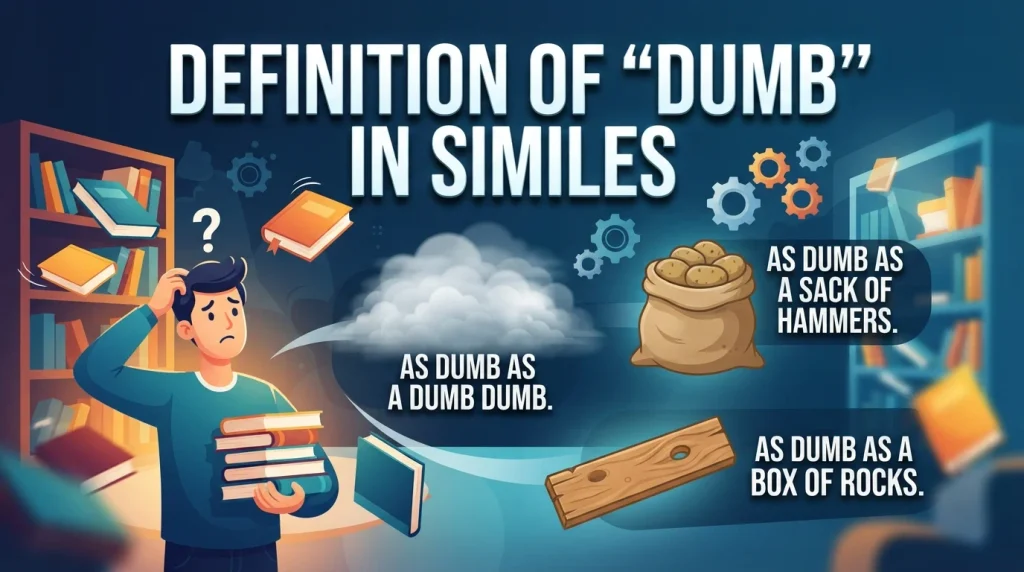
Definition of “Dumb” in Similes
The word dumb can have different meanings depending on context.
In modern informal English, dumb can mean unintelligent, foolish, or lacking good judgment. For example:
“That was a dumb mistake.”
Historically, “dumb” could also mean unable to speak, but this meaning is now generally considered outdated or insensitive when referring to a person.
When creating similes, it is often better to communicate the exact idea you mean. Instead of simply suggesting that someone is unintelligent, you might want to describe them as:
- confused
- clueless
- unaware
- foolish
- slow to understand
- inexperienced
- absent-minded
- forgetful
For example, “He looked as confused as a lost tourist” describes confusion rather than claiming that the person has low intelligence.
Definition of “Simile”
A simile is a figure of speech that compares two different things using words such as like or as.
Examples include:
- “He is as quiet as a mouse.”
- “She runs like the wind.”
- “I was as confused as a lost puppy.”
- “His explanation was like a puzzle with missing pieces.”
Similes are commonly used in:
- creative writing
- stories
- poems
- jokes
- social media captions
- everyday conversation
- speeches
- descriptions
A simile can make an ordinary idea more vivid and memorable.
Main Differences Between Common Similes for Dumb
There is no single “correct” simile for dumb. The best choice depends on what you actually want to communicate.
| Simile | Main Meaning | Tone | Common Context |
| As confused as a lost puppy | Confused | Mild/playful | Conversation |
| Like a deer caught in headlights | Shocked/confused | Humorous | Conversation |
| As clueless as a tourist without a map | Unaware | Playful | Writing/conversation |
| Like a computer with no internet | Unable to process information | Humorous | Technology |
| As lost as a ship without a compass | Directionless/confused | Creative | Writing |
| Like a broken calculator | Unable to work something out | Humorous | Jokes |
| As slow as a snail to catch on | Slow to understand | Teasing | Informal speech |
| Like a puzzle missing half its pieces | Difficult to understand | Creative | Writing |
| As sharp as a butter knife | Not intelligent/sharp | Sarcastic | Humor |
| Like a phone with a dead battery | Unable to function properly | Modern/humorous | Casual writing |
The important difference is what the comparison emphasizes.
For example, “as confused as a lost puppy” focuses on confusion, while “as sharp as a butter knife” is more sarcastic and directly suggests a lack of mental sharpness.
Types of Similes for Dumb
Similes for Confusion
These similes describe someone who does not understand what is happening.
Examples:
- As confused as a lost puppy.
- Like a deer caught in headlights.
- As lost as a tourist without a map.
- Like a student reading a book upside down.
- As puzzled as a cat looking at a mirror.
These expressions are useful when the person may not actually be unintelligent but simply does not understand a particular situation.
Similes for Lack of Awareness
These describe someone who does not notice or understand what is happening around them.
Examples:
- As unaware as a sleeping cat.
- Like someone walking through a room with their eyes closed.
- As clueless as a tourist without directions.
- Like a person searching for glasses while wearing them.
- As unaware as a fish of the water around it.
Similes for Slow Understanding
These expressions describe someone who takes a long time to understand something.
Examples:
- As slow to catch on as a snail.
- Like a computer stuck on loading.
- As slow as an old internet connection.
- Like a calculator trying to solve a riddle.
- As delayed as a message with no signal.
These are usually playful rather than literal.
Funny Similes for Dumb
Humorous similes can make the description less harsh.
Examples:
- As sharp as a butter knife.
- Like a computer with one percent battery.
- As useful as a chocolate teapot.
- Like a GPS that has forgotten where north is.
- As prepared as a penguin in the desert.
These work particularly well in jokes, captions, and informal writing.
Creative Similes for Dumb
Creative writing allows you to use unusual comparisons.
Examples:
- “His thoughts moved like a snail carrying a suitcase.”
- “Her reasoning was like a puzzle with half the pieces missing.”
- “His brain seemed as quiet as an empty library.”
- “He looked as lost as a sailor without a compass.”
- “The idea arrived in his mind like a delayed train.”
Grammar Guide
A simile is normally constructed by comparing one thing with another.
Two common structures are:
Subject + be + as + adjective + as + noun
Example:
“He was as confused as a lost puppy.”
Another common structure is:
Subject + verb + like + noun
Example:
“He looked like a deer caught in headlights.”
How Each Term Is Used in Sentences
The word like is normally followed by a noun or noun phrase.
Pattern:
Subject + verb + like + noun.
Example:
“She looked like a confused tourist.”
The word as can be used in the common simile pattern:
as + adjective + as
Examples:
- as dumb as a rock
- as confused as a lost puppy
- as slow as a snail
- as clueless as a newborn puppy
However, some expressions can sound insulting when applied directly to people.
A softer alternative is often better:
“He seemed as confused as a lost puppy.”
Instead of:
“He is as dumb as a rock.”
Common Mistakes Learners Make
One common mistake is confusing a simile with a literal statement.
“He is a rock.”
This is normally a metaphor, not a simile.
“He is as still as a rock.”
This is a simile because it uses “as.”
Another mistake is using like incorrectly.
Incorrect:
“He was like confused.”
Better:
“He was confused.”
Or:
“He looked like a confused person.”
Another common mistake is choosing a simile that does not match the intended meaning. If someone is temporarily confused, calling them “dumb” may be too strong.
Simple Rules to Remember
Remember these simple rules:
- A simile usually compares two things.
- Like is commonly followed by a noun.
- As…as is commonly used with an adjective.
- Choose the comparison according to the exact meaning.
- Use softer language when discussing real people.
- Consider whether the situation is serious, humorous, or informal.
- Avoid outdated uses of “dumb” that refer to someone’s ability to speak.
Quick Tips for Writing and Speaking
For casual conversation, use simple expressions:
“He looked as confused as a lost puppy.”
For humor, try an exaggerated comparison:
“His brain was like a computer running on one percent battery.”
For creative writing, use a fresh image:
“His thoughts wandered like a ship without a compass.”
For professional writing, avoid insulting comparisons. Instead, describe the specific issue:
“The explanation appeared difficult to understand.”
When to Use Each One
Different similes work in different situations.
In Education
A teacher might use a gentle comparison to describe confusion:
“The student looked as confused as a traveler without a map.”
This is more appropriate than directly calling the student dumb.
In Daily Conversation
Friends may use humorous expressions:
“I was as clueless as a tourist at first.”
This makes the situation sound playful.
In Creative Writing
Writers can use imaginative comparisons:
“His thoughts moved like a train that had forgotten its destination.”
This creates a stronger visual image.
In Comedy
Exaggerated comparisons can create humor:
“He was as sharp as a butter knife.”
The humor comes from comparing mental sharpness with an object that is not sharp.
In Social Media
Short similes can work well as captions:
“Me trying to understand the instructions: like a computer with no internet.”
When NOT to Use Each One
Not every simile is appropriate in every situation.
Avoid Insulting Similes in Formal Situations
Expressions such as:
“He is as dumb as a rock.”
may sound rude or unprofessional.
In formal writing, explain the actual problem instead.
Instead of:
“The employee was dumb.”
Use:
“The employee appeared unfamiliar with the procedure.”
Avoid Using “Dumb” When You Mean “Confused”
Someone can be confused without being unintelligent.
For example:
“She was as confused as a lost puppy.”
is different from:
“She was dumb.”
The first describes a temporary state. The second can be interpreted as a judgment about intelligence.
Avoid Outdated Meanings
Using “dumb” to describe a person as unable to speak is generally outdated and can be offensive. Modern writing should use more precise language such as non-speaking or unable to speak, depending on the intended meaning and context.
Which One to Use (Decision Guide)
Use this simple guide to choose an appropriate simile.
If you mean confused:
“As confused as a lost puppy.”
If you mean unaware:
“As clueless as a tourist without a map.”
If you mean shocked:
“Like a deer caught in headlights.”
If you mean slow to understand:
“As slow to catch on as a snail.”
If you want humor:
“As sharp as a butter knife.”
If you want a technology-related joke:
“Like a computer stuck on loading.”
If you want creative writing:
“Like a ship sailing without a compass.”
If you want professional language:
Avoid calling someone dumb and describe the specific difficulty instead.
Real-World Practical Examples
“Similes for Dumb” Examples
- Education:
“I felt as confused as a student holding a textbook in the wrong language.” - Daily Life:
“I was as clueless as a tourist without a map.” - Science:
“Without the instructions, I was like a scientist trying to work without any equipment.” - Business:
“Without the financial report, the new employee felt as lost as a driver without a GPS.” - Technology:
“My brain was like a computer stuck on loading.” - Conversation:
“I looked like a deer caught in headlights when they asked me that question.” - Writing:
“His thoughts wandered like a ship without a compass.” - Comedy:
“He was as sharp as a butter knife.”
“Simile” Examples
- Education:
“The classroom was as quiet as a library.” - Daily Life:
“She ran like the wind.” - Science:
“The chemical reaction spread like a wave.” - Business:
“The company grew like a rapidly spreading tree.” - Technology:
“The new software worked like a well-oiled machine.” - Conversation:
“He was as busy as a bee.” - Writing:
“The moon shone like a silver coin.” - Humor:
“My memory is like a computer with too many tabs open.”
Self-Assessment (Fill in the Blanks)
Complete each sentence with the most suitable word or simile.
- I will use ______ when referring to someone who is temporarily confused.
- I will use ______ when making a comparison with a noun.
- I will use ______ when describing someone who does not understand what is happening.
- “He looked ______ a deer caught in headlights.”
- “She was as ______ as a lost puppy.”
- A comparison using “like” is usually a ______.
- “As confused as a lost puppy” describes ______ rather than permanent intelligence.
- “As sharp as a butter knife” is usually a ______ expression.
- For professional writing, it is better to describe the specific ______ rather than insult someone.
- “He runs like the wind” is an example of a ______.
- “As slow as a snail” can describe someone slow to ______.
- “Like a computer stuck on loading” is a modern ______ comparison.
- If someone is shocked and confused, “like a ______ caught in headlights” is a suitable expression.
- “As clueless as a tourist without a map” suggests a lack of ______.
- A simile commonly uses “like” or ______.
- “He is a rock” is generally a ______ rather than a simile.
- “He is as quiet as a mouse” is a ______.
- In formal communication, insulting words such as “dumb” should generally be ______.
- If someone does not understand directions, “as lost as a traveler without a ______” can work as a creative comparison.
- The best simile depends on the intended meaning and ______.
Answers
- As confused as a lost puppy — because it describes temporary confusion.
- Like — because “like” commonly introduces a noun comparison.
- As clueless as a tourist without a map — because it suggests a lack of awareness or understanding.
- like — “He looked like a deer caught in headlights.”
- confused — “She was as confused as a lost puppy.”
- simile — because it compares two things.
- confusion — the expression describes being confused.
- humorous/sarcastic — it jokingly suggests a lack of sharpness.
- difficulty/problem — precise language is better in formal situations.
- simile — it compares running with the movement of the wind.
- understand — “slow to catch on” means slow to understand something.
- technology-related — it uses a computer as the comparison.
- deer — “like a deer caught in headlights.”
- awareness — it suggests someone does not know what is happening.
- as — “like” and “as” are common simile signals.
- metaphor — it directly identifies one thing with another.
- simile — it uses the “as…as” structure.
- avoided — especially in professional or formal communication.
- map — a map is associated with finding direction.
- context — the situation determines which expression sounds natural.
Final Verdict
“Similes for dumb” refers to creative comparisons that can describe confusion, cluelessness, slow understanding, foolishness, or a lack of awareness. The most appropriate expression depends on the exact meaning you want to communicate.
For confusion, “as confused as a lost puppy” is a gentle and familiar option. For lack of awareness, “as clueless as a tourist without a map” works well. For humorous writing, expressions such as “as sharp as a butter knife” can create a playful tone. Technology-based comparisons such as “like a computer stuck on loading” can also make modern jokes more relatable.
The key is to choose a simile based on meaning, tone, audience, and context. In formal situations, it is usually better to describe a person’s specific difficulty rather than label them “dumb.” A well-chosen simile should make your writing clearer, more vivid, and more engaging without creating unnecessary offense.
Conclusion About Similes For Dumb
Similes for dumb can make your writing more creative by describing confusion, cluelessness, slow understanding, or foolish behavior through memorable comparisons. Instead of simply saying that someone does not understand something, a simile can create a clear picture, such as being “as confused as a lost puppy” or “like a computer stuck on loading.” The right expression depends on your intended meaning, audience, and tone. Some similes are playful and suitable for jokes or casual conversations, while others work better in creative writing.
It is also important to remember that being confused does not necessarily mean someone lacks intelligence. For respectful communication, especially in formal situations, describing the specific difficulty is often better than using an insulting label. Overall, learning different similes for dumb helps you express ideas more vividly, naturally, and creatively while choosing words that fit the situation.
FAQs
What are similes for dumb?
Similes for dumb are creative comparisons used to describe someone or something as confused, clueless, foolish, slow to understand, or unaware. They commonly use words such as “like” or “as.” Examples include “as confused as a lost puppy” and “like a computer stuck on loading.” The best expression depends on the meaning and context.
What is a good simile for someone who is confused?
A good gentle simile for someone confused is “as confused as a lost puppy.” It creates a clear and memorable image without directly calling someone unintelligent. Another option is “like a deer caught in headlights,” which can describe someone who looks shocked, surprised, or temporarily unable to understand what is happening.
What is a funny simile for dumb?
A funny simile is “as sharp as a butter knife.” It humorously suggests that someone is not mentally sharp without making the statement completely literal. Other playful options include “like a computer stuck on loading” or “as clueless as a tourist without a map.” These expressions are generally better suited to casual or humorous contexts.
Is “as dumb as a rock” a simile?
Yes, “as dumb as a rock” is a simile because it compares a person’s intelligence with a rock using the “as…as” structure. However, it is a blunt and potentially insulting expression. For friendly, professional, or respectful communication, softer alternatives such as “as confused as a lost puppy” are usually more appropriate.
What is the difference between a simile and a metaphor?
A simile directly compares two things using words such as “like” or “as.” For example, “He was as confused as a lost puppy.” A metaphor makes a direct comparison without these words, such as “He was a lost puppy.” Both can make descriptions more vivid, but their grammatical structures are different.
Can I use similes for dumb in creative writing?
Yes, similes can be very effective in creative writing because they help readers visualize an idea. Instead of simply writing that a character was confused, you could say, “His thoughts wandered like a ship without a compass.” Creative comparisons can add humor, personality, and imagery while making descriptions more memorable.
What simile describes someone slow to understand?
A phrase such as “as slow to catch on as a snail” can describe someone who takes a long time to understand something. A modern humorous alternative is “like a computer stuck on loading.” These expressions are usually playful and should be used carefully when describing real people, especially in situations where respectful language is important.
What is a polite alternative to calling someone dumb?
A polite alternative is to describe the specific situation instead of judging the person’s intelligence. You might say, “He seemed confused,” “She was unfamiliar with the instructions,” or “They needed more explanation.” This approach is clearer and more respectful because it focuses on the person’s temporary difficulty rather than assigning a negative label.
What simile can describe someone clueless?
“As clueless as a tourist without a map” is a clear and playful simile for someone who does not know what is happening or what to do. It emphasizes a lack of awareness or direction rather than intelligence. This makes it useful when the intended meaning is confusion or unfamiliarity with a situation.
Why are similes useful when describing someone as dumb?
Similes make descriptions more vivid by turning an abstract idea into a recognizable image. Rather than simply saying someone is confused or slow to understand, a writer can create a memorable comparison. They are especially useful in stories, jokes, conversations, and creative writing, although the tone should always match the audience and situation.

