
Learning to use similes can make student writing more creative, descriptive, and memorable. A simile compares two different things using words such as “like” or “as” to help readers form a clear picture. In this guide, students will learn what similes are, how they work, when to use them, common mistakes to avoid, and plenty of practical examples.
Comparison Overview
A simile is a figure of speech that compares two different things to make an idea easier to understand or more vivid. For example, saying “The baby was as quiet as a mouse” helps the reader imagine just how quiet the baby was.
Similes are especially useful for students because they can improve:
- Creative writing
- Descriptive paragraphs
- Stories
- Poems
- Essays
- Speeches
- Personal narratives
- School assignments
- Character descriptions
- Explanations
Unlike a literal statement, a simile does not mean that two things are actually the same. When someone says, “He runs like the wind,” the person is not literally the wind. The comparison simply emphasizes that he runs very quickly.
Definition of a Simile
A simile is a figure of speech that directly compares two different things, people, places, ideas, or experiences using a comparison word such as like or as.
For example:
The classroom was as quiet as a library.
The classroom is not actually a library. The writer compares its quietness to a library to create a stronger mental image.
Another example is:
Her smile was like sunshine.
This comparison suggests that her smile was bright, warm, cheerful, or pleasant.
What Is the Purpose of a Simile?
The main purpose of a simile is to make writing more descriptive and interesting.
Compare these two sentences:
Plain:
The dog was very fast.
With a simile:
The dog was as fast as lightning.
The second sentence gives readers a stronger impression of speed.
Common Simile Words
The most common words used to create similes are:
- Like
- As
- As … as
- Similar to
- Resembles
However, like and as are by far the most common in everyday English and student writing.
Main Features of Similes
Similes usually contain two main ideas:
- The thing being described
- The thing it is being compared with
For example:
The snow was as white as a sheet of paper.
The snow is the thing being described, while the sheet of paper provides the comparison.
A good simile connects the two ideas through a shared quality such as:
- Speed
- Color
- Size
- Sound
- Strength
- Beauty
- Happiness
- Sadness
- Brightness
- Silence
- Temperature
- Movement
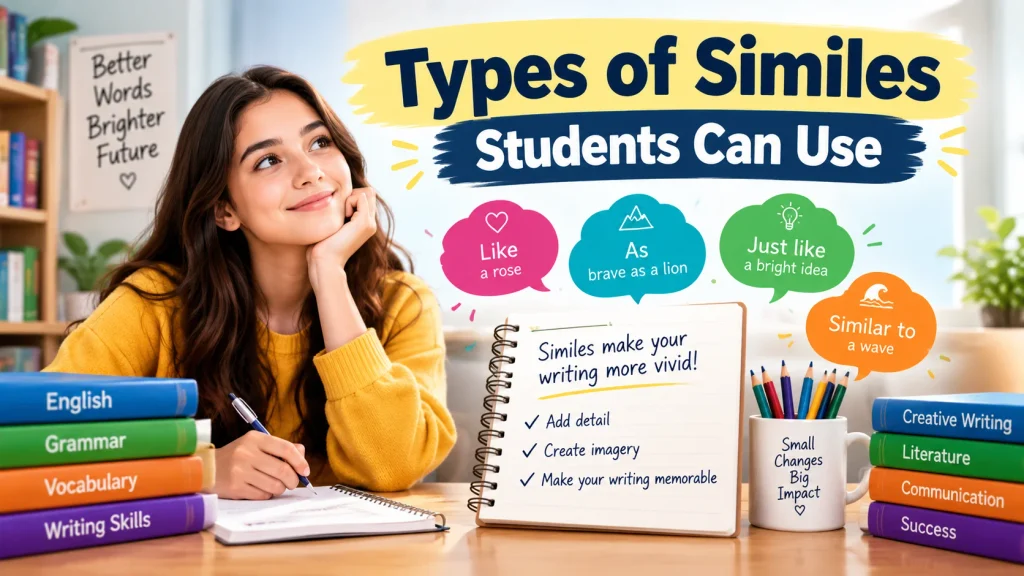
Types of Similes Students Can Use
Similes can be organized according to the type of quality or idea they describe.
Similes About Appearance
These compare how something looks.
Examples:
- Her eyes were like sparkling stars.
- The lake was as blue as the sky.
- His face was as pale as a ghost.
- The flowers looked like colorful jewels.
- The moon was like a silver coin.
Similes About Personality
These describe someone’s personality or behavior.
Examples:
- She was as gentle as a lamb.
- He was as brave as a lion.
- My little brother is as playful as a puppy.
- She was as stubborn as a mule.
- He is as wise as an owl.
Similes About Speed
These show how quickly something moves.
Examples:
- The cheetah ran like lightning.
- She moved as fast as a rocket.
- The boy ran like the wind.
- The car moved like a racing machine.
- The horse was as quick as lightning.
Similes About Sound
These compare sounds with familiar things.
Examples:
- The baby cried like a siren.
- The thunder sounded like a giant drum.
- Her voice was as soft as a whisper.
- The leaves rustled like paper.
- The alarm rang like a bell.
Similes About Feelings
Similes can make emotions easier to imagine.
Examples:
- He was as happy as a child on Christmas morning.
- She felt like a bird set free.
- My heart was pounding like a drum.
- He was as nervous as a cat.
- Her sadness felt like a heavy cloud.
When to Use Similes
Similes are particularly useful when students want to make writing more vivid.
In Stories
The dragon’s eyes glowed like two burning coals.
In Poems
The moon floated across the sky like a silver boat.
In Essays
The new student felt like a small fish in a huge ocean.
In Personal Narratives
My heart beat like a drum before I walked onto the stage.
In Descriptive Writing
The garden was as colorful as a rainbow.
In Speeches
Teamwork is like the gears in a machine because every part has an important role.
When NOT to Use Similes
Similes are useful, but they are not appropriate everywhere.
Avoid unnecessary similes when:
- You need extremely precise technical language.
- The comparison could confuse the reader.
- The subject requires a simple factual statement.
- The simile adds no useful information.
- You are repeating the same comparison too often.
For example, a science report might say:
Water boils at 100°C under standard atmospheric pressure.
A creative comparison such as:
Water boils like an angry volcano.
might be suitable in an informal explanation, but it should not replace precise scientific information when accuracy is the main goal.
Similes vs. Metaphors
Students often confuse similes with metaphors because both compare things.
A simile normally uses a comparison word such as like or as.
The boy was as brave as a lion.
A metaphor makes a direct comparison without using like or as.
The boy was a lion on the battlefield.
The boy is not literally a lion in either sentence. The difference is in how the comparison is constructed.
| Feature | Simile | Metaphor |
| Comparison | Directly signals comparison | Makes a direct comparison |
| Common words | Like, as | Is, was, are, becomes, etc. |
| Example | She runs like the wind. | She is the wind. |
| Purpose | Creates a clear comparison | Creates a stronger figurative statement |
| Student use | Stories, poems, descriptions | Stories, poems, persuasive and creative writing |
Which Type of Simile Should You Use?
There is no single simile that works best for every sentence. The right choice depends on what you want to describe.
Use a like simile when you want to compare an action or appearance:
The leaves danced like butterflies.
Use an as … as simile when you want to emphasize a quality:
The leaves were as green as emeralds.
For school writing, choose a comparison that is:
- Clear
- Relevant
- Easy to understand
- Appropriate for the audience
- Connected to the quality being described
Real-World Practical Examples
Simile Examples for Education
- The teacher’s explanation was as clear as crystal.
- The students worked like a well-trained team.
- The classroom was as quiet as a library during the test.
- The new concept spread through the class like a wave.
- Her handwriting was as neat as printed text.
Simile Examples for Daily Life
- My little sister sleeps like a log.
- The coffee was as hot as fire.
- The baby smiled like a little sunshine.
- The old man walked as slowly as a turtle.
- The streets were as busy as a marketplace.
Simile Examples for Science
- The planet looked like a tiny marble in the model.
- The electric current moved like water through a pipe.
- The cell membrane acts like a protective wall.
- The volcano erupted like a giant firework.
- The stars appeared like tiny lights in the night sky.
Simile Examples for Business
- The new product spread through the market like wildfire.
- The manager was as calm as a lake during the meeting.
- The team worked like a well-oiled machine.
- The company’s growth was as rapid as a rocket.
- The negotiation moved like a slow train.
Simile Examples for Writing
- The words flowed like a gentle river.
- Her story was as colorful as a painting.
- His imagination was like an endless ocean.
- The ending arrived like a sudden storm.
- The character’s fear grew like a dark shadow.
Simile Examples for Technology
- The computer processed the information like a lightning-fast machine.
- The new application spread like wildfire online.
- The screen was as bright as the midday sun.
- The robot moved like a human.
- The internet connected people like an invisible bridge.
Simile Examples for Conversation
- I’m as hungry as a wolf.
- She sings like an angel.
- He’s as busy as a bee today.
- You look as fresh as a daisy.
- That news spread like wildfire.
Simile Examples for Nature
- The clouds floated like ships across the sky.
- The river moved like a silver ribbon.
- The moon was as bright as a lantern.
- The flowers were like colorful stars.
- The wind whispered like a soft voice.
More Simile Examples for Students
Here are additional examples students can use as inspiration.
Similes About Happiness
- She was as happy as a child with a new toy.
- His smile shone like the morning sun.
- They danced like children at a celebration.
- Her happiness spread like sunshine.
- He felt light as a feather.
Similes About Courage
- She was as brave as a lion.
- He stood like a soldier.
- The firefighter moved like a hero.
- She faced the challenge as boldly as a warrior.
- His courage was as strong as steel.
Similes About Fear
- He shook like a leaf.
- Her face was as pale as a ghost.
- My heart raced like a speeding car.
- He was as nervous as a cat.
- Fear followed him like a shadow.
Self-Assessment: Fill in the Blanks
Complete each sentence with a suitable simile or comparison word.
- The classroom was as quiet ______ a library.
- The boy ran ______ the wind.
- Her smile was ______ sunshine.
- The baby slept ______ a log.
- The warrior was as brave ______ a lion.
- The stars looked ______ tiny diamonds.
- My heart was beating ______ a drum.
- The water was as cold ______ ice.
- The old car moved ______ a turtle.
- The children were busy ______ bees.
- The moon shone ______ a silver lamp.
- The teacher explained the lesson ______ a clear guide.
- The river moved ______ a snake through the valley.
- She was as gentle ______ a lamb.
- The thunder sounded ______ a giant drum.
- His face became as red ______ a tomato.
- The new student felt ______ a fish out of water.
- The athlete moved ______ lightning.
- The clouds looked ______ fluffy cotton.
- Her voice was as soft ______ a whisper.
Answers
- as — The structure is “as quiet as a library.”
- like — “Ran like the wind” compares the boy’s speed with the wind.
- like — “Smile was like sunshine” creates a comparison.
- like — “Slept like a log” is a common simile describing deep sleep.
- as — The correct structure is “as brave as a lion.”
- like — The stars are compared with tiny diamonds.
- like — “Beating like a drum” compares the sound or rhythm of the heartbeat.
- as — “As cold as ice” uses the as…as structure.
- like — The car’s slow movement is compared with a turtle.
- like — “Busy like bees” compares the children’s activity with bees.
- like — The moon is compared with a silver lamp.
- like — The teacher’s guidance is compared with that of a clear guide.
- like — The river’s movement is compared with a snake.
- as — “As gentle as a lamb” is the correct pattern.
- like — The sound of thunder is compared with a giant drum.
- as — “As red as a tomato” is the correct pattern.
- like — The student’s unfamiliar feeling is compared with being a fish out of water.
- like — “Moved like lightning” emphasizes very fast movement.
- like — The clouds are compared with fluffy cotton.
- as — “As soft as a whisper” uses the as…as structure.
How to Create Your Own Similes
Creating original similes becomes easier when you follow a simple process.
Step 1: Choose Something to Describe
Start with a person, object, place, action, or feeling.
Example:
The boy was nervous.
Step 2: Identify Its Main Quality
Ask what makes the subject interesting.
The boy’s main quality is nervousness.
Step 3: Think of Something That Represents That Quality
A cat can represent nervousness.
Step 4: Connect the Ideas
The boy was as nervous as a cat.
You can also create:
His hands shook like leaves in the wind.
Step 5: Check the Comparison
Ask whether the reader can understand why the two things are being compared.
A strong simile should add meaning rather than simply sound unusual.
Tips for Students Writing Similes
Students can make their writing stronger by following these practical tips.
Choose Familiar Comparisons
Common objects can make similes easier to understand.
Her face was as bright as the sun.
Avoid Overused Comparisons When Possible
Common expressions are useful, but original comparisons can make creative writing more memorable.
Instead of:
The moon was like a ball.
Try:
The moon floated above the trees like a silver lantern.
Match the Simile to the Subject
A comparison should fit the situation.
For example:
The runner moved like a snail.
This could work if you want to emphasize that the runner was very slow, but it would be inappropriate if you want to describe a fast runner.
Keep the Meaning Clear
The reader should understand the connection without having to guess what you mean.
Do Not Force a Simile
If a sentence is already strong without a comparison, you do not need to add one.
Good writing is not about using as many figures of speech as possible. It is about using the right figure of speech in the right place.
Why Are Similes Important for Students?
Similes help students develop stronger communication and writing skills. They encourage learners to think creatively about similarities between different things.
Using similes can help students:
- Expand descriptive vocabulary
- Make stories more interesting
- Improve creative writing
- Explain unfamiliar ideas
- Develop imagination
- Create stronger mental images
- Make speeches more engaging
- Express emotions more clearly
- Add personality to writing
- Make poems more memorable
For example, instead of writing:
The storm was frightening.
A student could write:
The storm roared like an angry giant.
The second sentence creates a stronger image and gives the reader a better sense of the storm’s power.
Final Verdict
Similes are simple but powerful tools that can make student writing clearer, more creative, and more memorable. A simile compares two different things, usually with “like” or “as,” to highlight a shared quality. Students can use similes to describe people, emotions, objects, actions, places, sounds, and experiences.
The most important rule is to make the comparison meaningful and easy to understand. Use like when directly comparing something with another thing, and use as … as when emphasizing a particular quality. Avoid confusing comparisons and do not overload your writing with them.
With regular practice, students can create original similes that bring stories, essays, poems, and everyday descriptions to life.
Conclusion
Simile examples for students offer a simple and creative way to make writing more vivid, expressive, and memorable. By comparing one thing with another using words such as “like” and “as,” students can help readers clearly imagine people, places, emotions, actions, and experiences. Whether used in stories, poems, essays, classroom assignments, or everyday descriptions, well-chosen similes can turn ordinary sentences into engaging writing. The key is to choose comparisons that are meaningful, easy to understand, and appropriate for the context. Students should also avoid forcing too many similes into a single paragraph, as strong writing depends on balance and clarity.
With regular practice, learners can develop original comparisons that show creativity while improving their vocabulary and descriptive skills. Understanding similes is not only useful for English class—it is a valuable communication skill that can help students express ideas with greater imagination and confidence.
FAQs
What is a simile?
A simile is a figure of speech that compares two different things to highlight a shared quality. It commonly uses words such as “like” or “as.” For example, “The classroom was as quiet as a library” compares the classroom’s silence with the familiar quietness of a library.
Why are similes important for students?
Similes help students make their writing more descriptive, imaginative, and interesting. They allow readers to visualize ideas instead of simply receiving basic information. Students can use similes to describe characters, emotions, settings, objects, sounds, and actions in stories, poems, essays, speeches, and other forms of creative writing.
What are some easy simile examples for students?
Simple examples include “She runs like the wind,” “He is as brave as a lion,” “The baby slept like a log,” and “The stars looked like diamonds.” These examples are easy for students to understand because the comparison connects a familiar quality with something readers already recognize.
What words are commonly used in similes?
The words “like” and “as” are most commonly used in similes. Examples include “The water sparkled like diamonds” and “The room was as quiet as a library.” Students should choose the structure that naturally fits the sentence and clearly communicates the intended comparison.
What is the difference between a simile and a metaphor?
A simile makes a comparison using words such as “like” or “as,” while a metaphor makes a direct comparison without those words. For example, “Her smile is like sunshine” is a simile, while “Her smile is sunshine” is a metaphor. Both can make writing more expressive and imaginative.
Can students use similes in essays?
Yes, students can use similes in essays when they support the topic and improve clarity or description. They are especially useful in personal, descriptive, narrative, and creative writing. In formal academic writing, however, students should use similes carefully and avoid comparisons that could make factual explanations less precise.
How can students create their own similes?
Students can create similes by choosing something they want to describe, identifying its main quality, and finding a familiar object or experience with a similar quality. For example, if someone is extremely nervous, a student might write, “He was as nervous as a cat.” The comparison should be clear and meaningful.
How many similes should students use in their writing?
There is no fixed number of similes students should use. The best approach is to use them when they genuinely improve the description or meaning. Too many comparisons can make writing feel repetitive or distracting. A few strong, relevant similes are usually more effective than filling every sentence with figurative language.
Can similes be used in poems and stories?
Yes, similes are especially useful in poems and stories because they help create vivid mental images and express emotions. Writers can compare characters, settings, sounds, movements, and feelings with familiar things. A thoughtful simile can make a fictional scene easier to visualize and help readers connect emotionally with the writing.
How can students improve their simile writing?
Students can improve by reading examples, practicing original comparisons, and checking whether each simile clearly communicates an idea. They should choose familiar comparisons, avoid confusing connections, and consider the audience. Reading the sentence aloud can also help students decide whether the simile sounds natural and contributes something useful to the overall writing.

